

Municipality Discharges Sewage into the Vaal River During Elections 2026
“I believe my cattle are falling ill from this water,” remarked Nosi Mane, a cattle herder from Jouberton, as he stood beside a sign expressing gratitude to individuals for “not polluting the environment.”
Mane, accompanied by his approximately two dozen cattle, was making his way to the shores of the Skoonspruit in Matlosana, North West, just beyond the Klerksdorp Wastewater Treatment Works (WWTW) located at the entrance of the township.
Over the 40 years he has resided here, Mane has observed the river undergoing a “transformation.”

Skoonspruit, which translates to “clean stream,” is ironically now a murky and foamy waterway that emits a foul odor.
Moreover, it serves as a tributary to the Vaal River, which provides fresh water to approximately one-third of South Africa’s population.
The City of Matlosana is currently under provincial administration, and its wastewater infrastructure has been deteriorating for years. Sewage spills and inadequately treated wastewater also contaminate the Jagspruit and Koekemoerspruit, which flow into the Vaal River.
In Kanana, located near Orkney, 15 km south of where we met Mane, we encountered Richard Ndlovu resting against a wall of a malfunctioning pump station.
Ndlovu gestured towards a manhole overflowing with raw sewage that has eroded a pathway towards the Skoonspruit, roughly 100 meters away. The Skoonspruit converges with the Vaal River approximately 5 km downstream.
“It has been this way for years,” Ndlovu stated.
He mentioned that his church group gathers near where the Jagspruit merges with the Skoonspruit every Sunday for baptisms and prayers, asserting that the water cleanses one as it is “protected by God.”
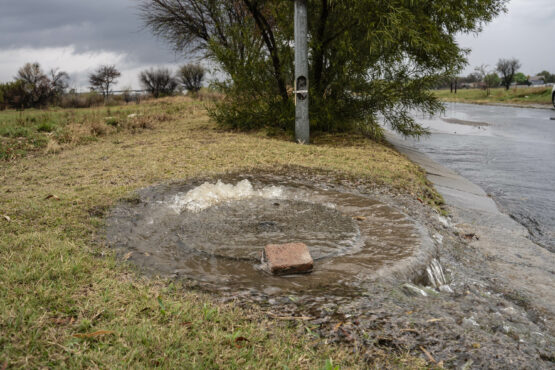
Raw sewage overflowing from a manhole into the streets of Klerksdorp, part of the City of Matlosana Local Municipality in the North West province.
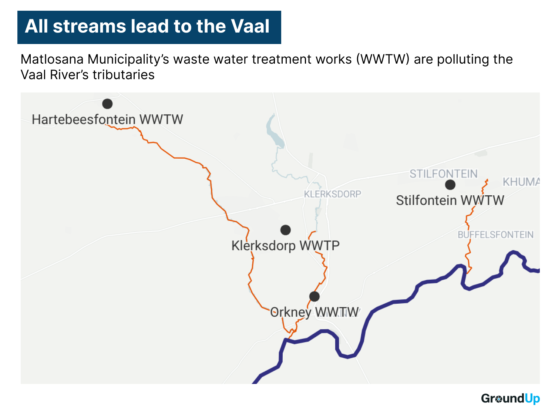
The condition of the Skoonspruit endangers communities and farmers who rely on the water for irrigation. Sewage can introduce dangerous pathogens into the water, raising the risk of diseases like diarrhoea and cholera.
Furthermore, the organic matter and nutrients found in wastewater can decrease dissolved oxygen levels, leading to conditions where fish, frogs, and plants may not survive.
GroundUp conducted water quality tests in the Skoonspruit, downstream from the Klerksdorp and Orkney WWTWs, where inadequately treated and raw sewage enters the waterway. We employed citizen-science screening kits to test for coliform bacteria and E. coli.
ADVERTISEMENT
CONTINUE READING BELOW
The initial test was an AquaScreen, a rapid screening method for bacteria, including coliform bacteria, which naturally occur in the environment and in the intestines of warm-blooded animals.
According to the testing process, if the water turns black after 36 hours, this signifies the presence of coliform bacteria; a clear or yellow result is regarded as negative.
Our tests turned a dark, tar-like black remarkably fast.
Next, we conducted a Petrifilm test to screen for E. coli and…