

Apple’s Ternus Confronts High Expectations After Cook’s 2300% Surge
On Tuesday, Tim Cook of Apple Inc. officially passed the leadership baton to John Ternus, concluding a remarkable tenure as CEO that solidified the company’s status as a legendary global brand and transformed its stock into one of the most dependable investments.
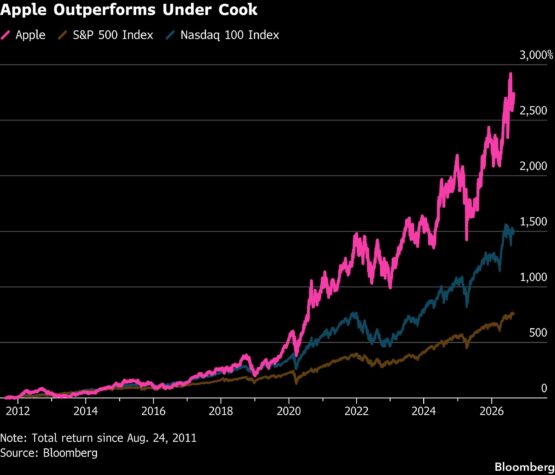
Under Cook, shares surged by 2,258%, following his acquisition of the role from the iconic founder Steve Jobs after market closure on August 24, 2011. Cook took the helm of a company valued at under $350 billion and grew it into a multifaceted business worth $4.6 trillion, which now also includes products like watches, AirPods, and various financial services.
“While Steve Jobs’ legacy was monumental, Cook leaves behind his own significant legacy, shaped by a distinctly different strategy for expansion,” remarked Chris Brigati, chief investment officer at SWBC. “He has undoubtedly accomplished remarkable feats as CEO, benefiting every shareholder, potentially exceeding expectations set when he began.”
On Tuesday morning, Apple shares dipped by 0.6% amid a wider tech market decline.
Ternus will encounter an immediate challenge next week, poised to reveal a new foldable iPhone model along with other product enhancements. In premarket trading on Tuesday, Apple shares remained largely unchanged as Ternus took charge.
“Ideally, Ternus will synergize the approaches of Jobs and Cook,” Brigati noted, highlighting Cook’s consistent, positive leadership juxtaposed with the extraordinary innovation and remarkable growth seen during Jobs’ tenure.
ADVERTISEMENT
CONTINUE READING BELOW
The stock gains achieved by Apple during Cook’s leadership become even more significant when dividends are considered. Throughout his tenure, shares surged an impressive 2,716% on a total-return basis. In comparison, the S&P 500 Index experienced a 757% increase—including dividends—while the technology-heavy Nasdaq 100 Index rose by 1,499% over the same duration.
This performance places Apple among the top 30 performers in the S&P 500 during that timeframe, albeit far behind Nvidia, which has experienced an astounding gain exceeding 73,000%. Other major tech companies, including Tesla and Broadcom, also surpassed Apple’s performance during Cook’s leadership.
“Cook’s legacy reflects his steady approach during a lengthy period marked by significant shifts in the tech landscape,” stated Allen Bond, managing director and portfolio manager at Jensen Investment Management, which holds shares of Apple.
Although several firms tied to artificial intelligence infrastructure—such as Micron Technology and Seagate Technology Holdings—have outperformed Apple, the stock has thrived due to its reputation as an anti-AI investment during periods of concern about the technology. Recently, its 40-day correlation with the S&P 500 turned negative for the first time in over a decade.
“Tim Cook has fostered a market cap growth rate of approximately $32 million every hour for nearly 15 years,” analyzed Bank of America’s Wamsi Mohan in an August 20 report. Apple was the first company to surpass a $3 trillion market valuation and has consistently held the title of the world’s largest corporation.
The stock constitutes 7% of the S&P 500, rising from less than 3.3% in 2011. Its peak weighting reached close to 7.9% just last month.
During Cook’s leadership, revenue consistently grew, with sales increasing from $157 billion in Apple’s fiscal 2012—his first full year as CEO—to $416 billion in the most recent fiscal period. By the close of Apple’s fiscal year 2026, anticipated revenue is projected to hit $477 billion.
ADVERTISEMENT:
CONTINUE READING BELOW
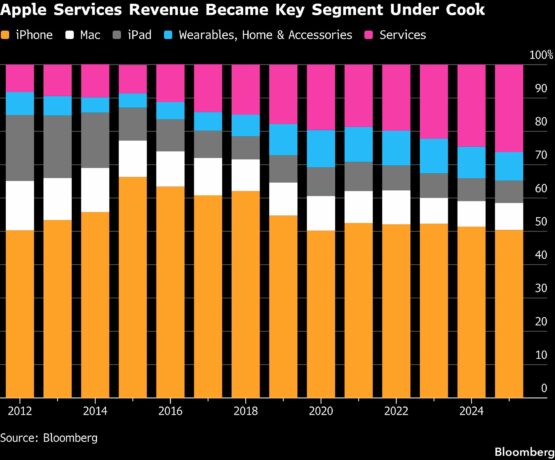
A significant contributor to revenue growth has been Apple Services. In fiscal 2025, the company generated over $109 billion from this sector, accounting for more than a quarter of total sales, as indicated by Bloomberg’s compiled data. Comparatively, in fiscal 2013, services revenue was merely $16 billion, or 9.4% of Apple’s overall revenue.
During his tenure, Cook oversaw successful product launches like the Apple Watch and AirPods. However, other initiatives, such as the Vision Pro headset and an unsuccessful venture into autonomous vehicles, did not meet expectations, eliciting criticism regarding Apple’s perceived decline in innovation. The company’s modest AI developments have sparked concerns among some investors about missed opportunities.
“The expansion into services is arguably Cook’s most notable achievement since it delivers high-margin, recurring revenue, making it one of Apple’s fastest-growing categories,” Bond commented. “However, his main shortcoming may be in AI, especially given that a successor with a strong engineering and product background will be taking over.”
ADVERTISEMENT:
CONTINUE READING BELOW
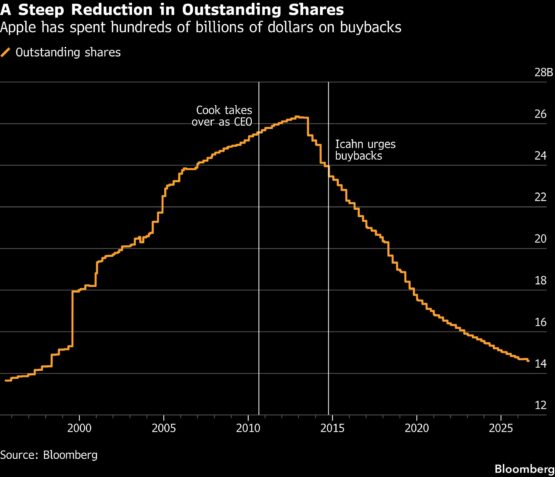
A key aspect of Cook’s legacy has been his emphasis on stock buybacks, which have led to a nearly 45% reduction in Apple’s outstanding shares since their peak in 2012, bringing the count to its lowest level since 1998.
Since fiscal 2012, Apple has allocated over $840 billion for buybacks, as indicated by company reports through the first quarter of 2026. In 2014, billionaire activist investor Carl Icahn urged Apple to enhance its buyback efforts, suggesting the stock was undervalued.
ADVERTISEMENT:
CONTINUE READING BELOW
Under Ternus, there may be a shift in the company’s risk tolerance, per Bank of America’s Mohan. Apple has moved away from its cash-neutral goal, which “could indicate a phase of increased investment in R&D, capital expenditures, and larger mergers and acquisitions,” he stated. “Given the AI landscape, a shift in strategy toward a faster pace of change might be necessary.”
Though Cook enjoys significant support, Wall Street’s sentiment toward the company is more reserved. Among the 58 analysts covering the stock tracked by Bloomberg, only 34 have given buy ratings. In contrast, around 95% of analysts monitoring major competitors like Microsoft, Nvidia, and Amazon are bullish on those stocks.
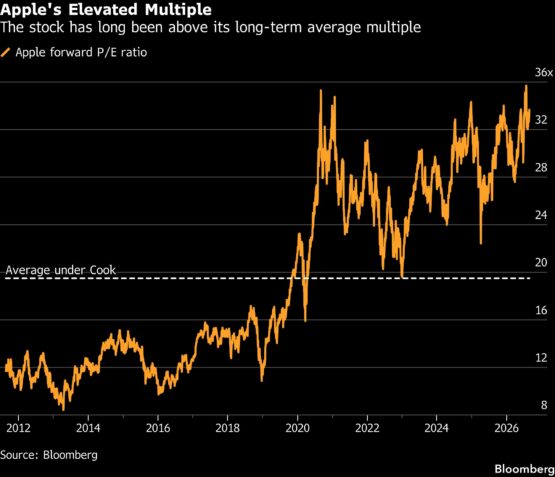
An increasing number of skeptics are emerging regarding Apple, many of whom express concerns over the stock’s high valuation. Currently, Apple trades at roughly 33 times earnings projected for the next year, compared to a 10-year average of 23. When Cook started, the multiple was about 12.
“While he may not possess the visionary charisma of Jobs or the same product-centric focus, everything Cook implemented was aimed at reinforcing Apple’s ecosystem and operations—an undeniably effective strategy for elevating the company’s value,” Bond concluded. “The stock performance reflects that success.”
© 2026 Bloomberg