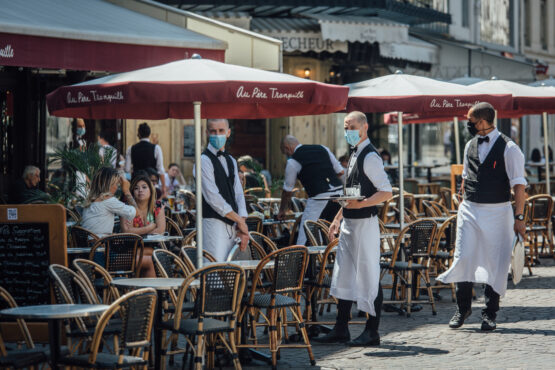
A Critical Moment for France’s Culinary Tradition
At the Marché International de Rungis, the enormous wholesale food market often referred to as “The belly of Paris,” cheese distributor Philippe Ammiche is increasingly struggling to maneuver through the incessant piles of boxes arriving from Italy.
An hour’s drive away in Beauce, a region renowned as France’s granary, wheat grower Eric Thirouin is enduring a fourth consecutive year of financial losses due to soaring temperatures and uncertainties regarding the fate of his 500-year-old farm.
Further south in Languedoc, winemaker Franck Saillan faces similar existential concerns as he gets ready to uproot vines and curtail production.
When it comes to French cuisine, wine, cheese, and bread symbolize the core of national identity. However, they now pose the greatest threat to France’s status as Europe’s leading food nation as cooking habits shift, alcohol consumption declines, and producers feel the pinch.
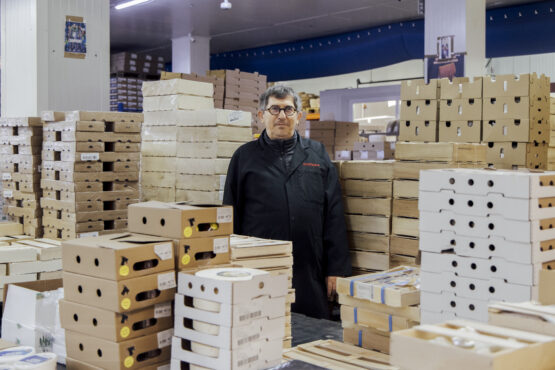
Philippe Ammiche, CEO of Buisson, a cheese and deli meat wholesaler at the Rungis Market, on 3 June. Image: Cyril Marcilhacy/Bloomberg
From the sugar industry shaped by Napoleon that now faces factory closures to wheat exports feeling the pressure from lower-cost competitors like Russia, the decline is evident throughout a nation that once dominated global gastronomy.
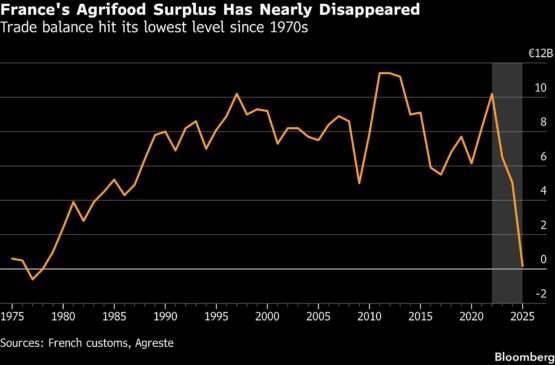
Wine exports have hit their lowest point in over 15 years. Mozzarella is now competing with local cheeses, and half of the chickens consumed in France are imported. Last year, the agrifood surplus dropped to its lowest level in nearly five decades.
Spain is poised to surpass France as Europe’s largest producer in a few years, with Italy and Poland potentially following suit.
Read:
France’s 2024 wine production anticipated to decrease by 22% due to adverse weather
Champagne exports continue to decline as luxury market slows
In response to these challenges, President Emmanuel Macron’s administration declared an “agricultural war.” They expedited emergency legislation that includes prioritizing French products in schools and loosening restrictions on expanding livestock buildings, pesticide use, and essential irrigation projects, a recurrent complaint among farmers. The law was passed in August.
Additionally, the government is set to announce a support package worth several hundred million euros to assist farmers affected by drought and heat this summer.
Concerns about the decline of French gastronomy have persisted for over a century, from fears of losing culinary dominance to Spain, to diminishing standards and the encroachment of fast food giants like McDonald’s. French farmers have also been vocal about their struggles over the years.
While the nation continues to be a significant global player, la crise is infiltrating the terroir, undermining France’s soft power and placing further strain on a crucial political demographic ahead of next year’s presidential elections.
The factors contributing to this shift are numerous.
Farm production has been impacted by broader trends such as trade wars, economic slowdowns, and various animal diseases. The current conflict in Iran has raised costs for fertilizers and fuel.
Additionally, climate change has dealt a severe blow. This year is shaping up to be one of the most devastating wildfire seasons in recent memory, with global broadcasts showing flames advancing toward Bordeaux over the summer. Approximately 96,500 hectares have already been scorched, more than two and a half times the total area burned in 2025.
Yet, some challenges are self-inflicted. France may have taken its role as a leading producer for granted.
“Many of our strengths and certainties have been disrupted,” stated Sébastien Abis, a research associate at the French Institute for International and Strategic Affairs, a Paris think-tank.
“While the rest of the world has accelerated, France has remained somewhat stagnant. The pressing issue for French agriculture and the food sector is determining whether we are ready to pursue ambition once more.”
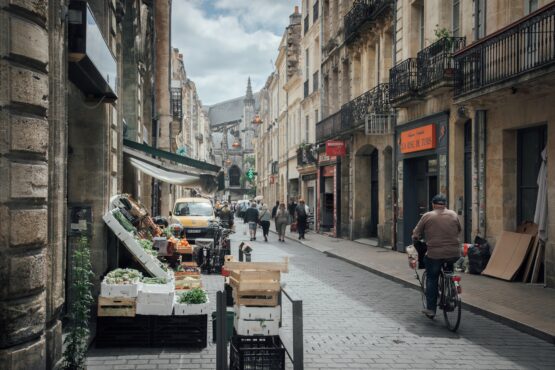
Bordeaux is synonymous with France’s wine and food culture. Image: Cyril Marcilhacy/Bloomberg
In Carcassonne, vineyards extend across the sunlit fields surrounding the city’s ancient fortress, where tourists relax in stone courtyards, enjoying local wines and dishes like duck confit.
Winemakers in this area, located roughly 700 kilometers (440 miles) south of Paris, produce Pays d’Oc wines. With some of the oldest vineyards in France, the region is celebrated for its bold, fruity reds. Saillan’s family has been crafting wine in Villemoustaussou for more than 400 years.
ADVERTISEMENT
CONTINUE READING BELOW
Read: How the wine landscape will transform in 2026
He has witnessed the Aude plains around Carcassonne experience a sequence of severe droughts followed by persistent flooding. Last summer, the region was devastated by wildfires that obliterated nearly half of the wine harvest.
“We have been beset by a multitude of challenges,” Saillan remarked. “We faced a cumulative impact of both drought and heatwaves. It was absolutely catastrophic.”
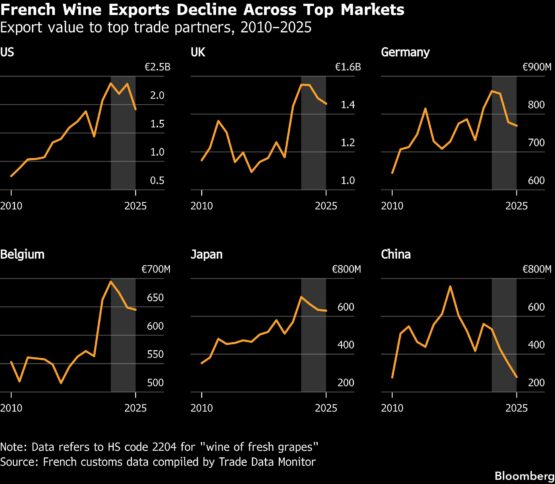
Wines and spirits remain France’s top agrifood export, yet sales overseas continued to decline into 2026, impacted by Donald Trump’s tariffs, lower demand from China, and decreasing alcohol consumption overall. Extreme weather led to one of the smallest harvests in five decades last year.
France, which contains one-tenth of the world’s vineyards, has lost a third of its vineyard area over the past 50 years and anticipates further reductions. To manage capacity, improve quality, and eventually drive prices higher, the government is financially incentivizing winemakers to uproot their vines.
Once this year’s harvest concludes, around 54,000 hectares of vines will have been removed at a cost of €217 million ($252 million) over the past two years, according to the agriculture ministry. Some of this wine will be repurposed for hand sanitizers.
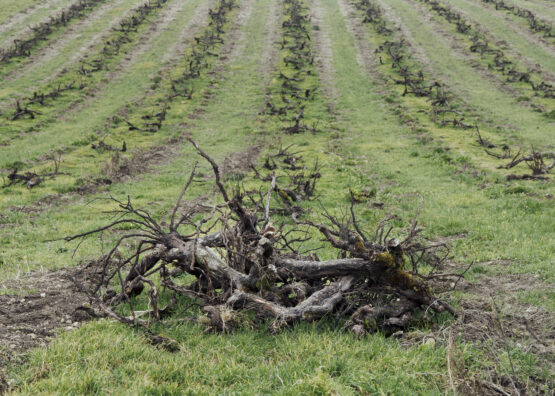
Uprooted vines in the Cognac region of southwestern France. Image: Cyril Marcilhacy/Bloomberg
Saillan will receive approximately €40,000 in compensation to remove 10 hectares from his total of 58 hectares, which will then be utilized by a neighbor for grain cultivation. “Economically, it’s rapidly becoming very challenging,” he noted.
Food has served as a vehicle for France’s soft power since the 17th century, when the extravagant feasts of Louis XIV at Versailles showcased wealth and prestige, dazzling royal guests who emulated French fashion and culinary standards.
However, it wasn’t until severe shortages from World War II that France emerged as a global food exporter.
Mechanization, fertilizers, and farm consolidation initiated this transformation, and under President Charles de Gaulle, a multitude of family farms became a key part of the nation’s social fabric. The European Union’s Common Agricultural Policy commenced in 1962, providing financial support for farmers.
Read: LVMH fashion unit’s growth hindered by Iranian conflict
As West Germany grew into Europe’s industrial powerhouse, France established itself as one of the world’s most productive nations in grains, wine, and dairy. Over time, however, the narrative morphed into one of exclusivity.
France was at the forefront of protecting regional food and wine designations and establishing the Michelin star system for restaurants, thereby setting the global benchmark for culinary excellence.
In time, the government began to focus on exporting premium products like Champagne, fine wines, foie gras, and artisanal brie, akin to the LVMH model of exporting prominent French luxury textile brands, as highlighted by Yannick Fialip, president of the National Center for the Promotion of Agricultural and Food Products. “In hindsight, this has proven to be a miscalculation.”
French exports have proven susceptible to economic downturns or geopolitical backlash from importing countries, illustrated when China curtailed imports of French Cognac or when Trump implemented heavy tariffs on its wine bottles.
Meanwhile, more widely available and affordable Italian produce has expanded its reach. While French exports rose by 2% last year, Italian agrifood exports increased by 5%.
Earlier this year, farmers drove their tractors into Paris and tossed potatoes in protest against the EU trade pact with Mercosur as the French government sought to portray itself as a defender of farmers against competition from Latin American producers.
In 2024, they were among the most visible participants in a wave of protests throughout Europe, prompting a reassessment of EU environmental policies. France remains the primary recipient of EU agricultural subsidies, receiving approximately €9 billion annually.
“French farmers are rightly renowned for their protests,” claimed Venus Bivar, associate professor of environmental history at Oxford University. “They feel a sense of entitlement concerning what they are owed by the EU and the French government.”
However, there are deeper forces at play beyond politics. The lockdowns during the COVID pandemic and the rising cost of living have contributed to shifting societal patterns – including how and what people eat, how they cook, and how much they consume.